
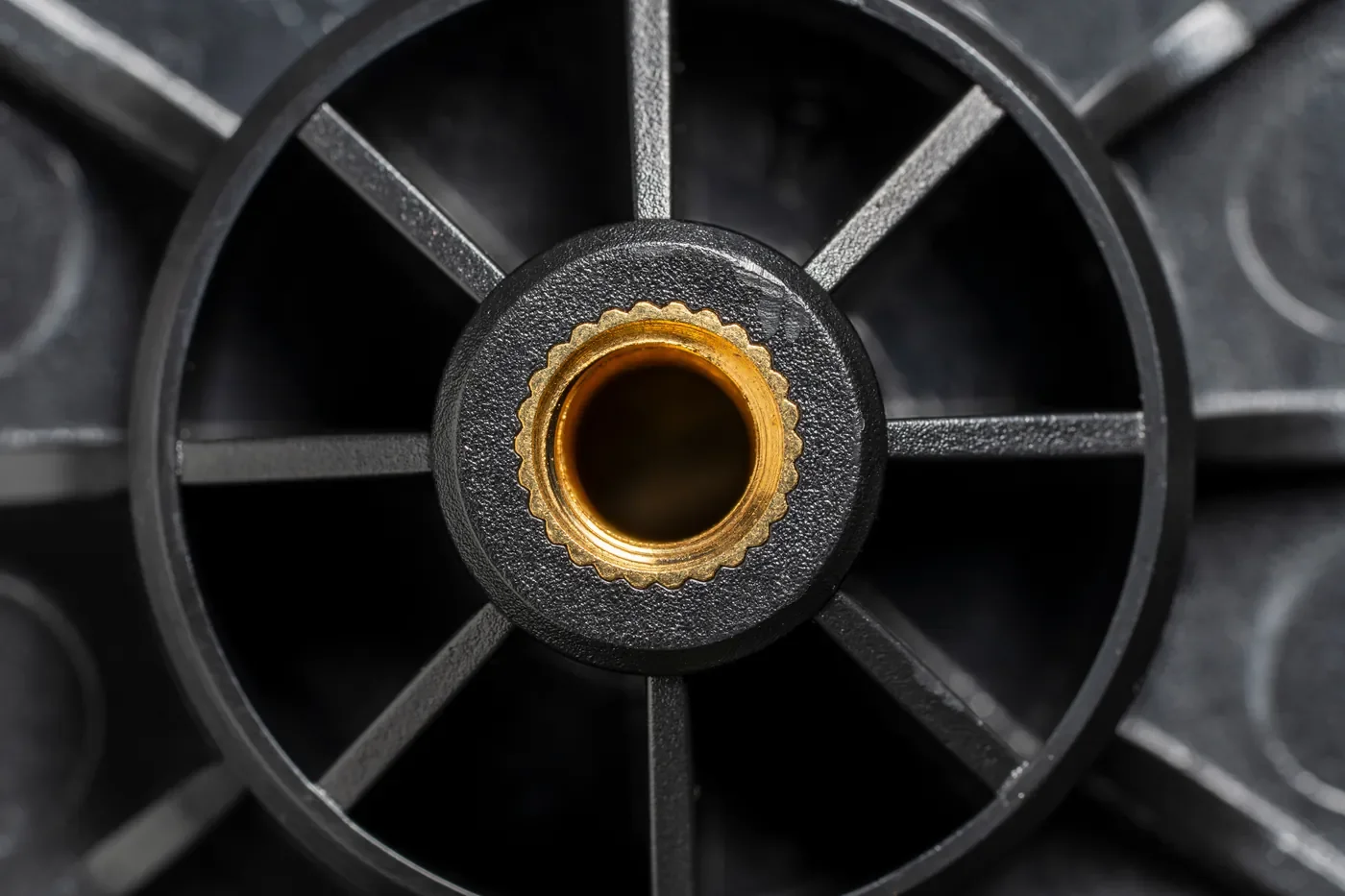
Industrial equipment components sometimes need to combine the design flexibility of plastic with the functional properties of another preformed component. Insert molding lets manufacturers incorporate components of another material, such as metal stampings, powdered metal, or machined inserts, directly into a plastic component during injection molding. For industrial injection plastics, the process requires coordination between the insert, plastic material, component geometry, and molding conditions to produce a part that performs as intended.
When Industrial Components Need Inserts
Plastic components often need to interface with hardware or other equipment components. Depending on the application, molded-in inserts can provide features that would be difficult to achieve with plastic alone. Threaded metal inserts are one common example. They provide fastening points for screws or bolts, particularly in applications where connections may need to be assembled and disassembled during equipment manufacturing or service.
The decision to use an insert depends on the component's function and operating conditions. Plastic under sustained load gradually loses clamp force through creep and stress relaxation, so a screw threaded directly into a molded boss can loosen over time, especially with vibration or repeated service. A metal thread keeps its dimensions under the same load, and an insert's larger outer diameter spreads the fastener load across more of the surrounding plastic. An insert may be appropriate when the connection experiences repeated fastening, higher mechanical loads, or other demands that a molded feature can't meet.
Some components need an insert for a reason other than strength. Plastic is an electrical and thermal insulator, so a part that has to carry current, ground a frame, or move heat needs a metal path through it. Copper or brass inserts molded into the part can serve as terminals, grounding points, or thermal paths while the rest of the component stays plastic.
How Insert Molding Integrates The Insert With Plastic
Insert molding involves positioning a compatible component inside the mold before injecting molten plastic. As the plastic fills the cavity, it flows around the insert and forms the surrounding component. Once the material cools and solidifies, the insert is encased within the molded part, with the insert's functional features exposed. The insert's geometry and position influence how well it is incorporated into the component. Knurling, grooves, and other mechanical retention features can help prevent the insert from moving or rotating, depending on the application and insert design.
Manufacturing Considerations To Address Before Production
When developing an insert-molded component, equipment manufacturers must define how the finished part will function. The insert's purpose, location, dimensional requirements, and expected operating conditions all influence the molding approach. Discussing these requirements with the injection molder early can help identify potential issues before tooling is finalized.
Some of the considerations worth addressing include:
Define what the insert needs to accomplish — Is it providing a threaded connection, a mounting point, electrical insulation, a wear surface, or another function? The intended purpose helps determine the appropriate insert material, geometry, and placement. The industrial equipment manufacturer should communicate the loads, operating conditions, and functional requirements the insert must accommodate.
Identify material requirements — The insert and molding resin must be suitable for the intended application and compatible with the molding process. This includes considering temperature exposure during molding, differences in thermal expansion, and how the two materials will interact in service. Manufacturers should discuss material options with their molder, particularly when using specialty plastics, or other materials with different thermal properties.
Establish insert location and dimensional requirements — Insert placement may affect how the component fits with other equipment parts or how it performs during assembly. Manufacturers should identify critical dimensions, positioning requirements, and any interfaces that must remain consistent. Drawings should clearly communicate these requirements so the molder can evaluate how to accommodate them in the tooling and production process.
Discuss retention and performance requirements — The insert must remain securely positioned and perform its intended function throughout the component's service life. Manufacturers should communicate whether it will experience repeated fastening, rotational forces, vibration, pullout loads, or other stresses. The injection molder can then evaluate appropriate insert geometry and retention methods.
Ask how insert placement affects the molding process — Insert location and geometry can influence mold design, plastic flow, and the finished component. Manufacturers should ask whether the proposed insert configuration creates any molding challenges, whether design adjustments are advisable, and whether the insert can be positioned consistently during production.
When Insert Molding Can Simplify Production
Insert molding can reduce the number of separate manufacturing and assembly operations required to produce an industrial component. When a metal feature is incorporated during molding, manufacturers may avoid installing that feature through a separate fastening, pressing, or joining operation.
This can simplify material handling and reduce the number of individual components that must move through production. It can also help maintain consistent positioning of metal features from part to part, provided the molding process and insert placement are properly controlled.
However, insert molding is not automatically the most economical approach. The cost of the inserts, mold configuration, production volume, and any remaining secondary operations all influence the overall manufacturing cost. The comparison should consider the complete production sequence rather than just the molding operation.
Working With a Molder on Industrial Injection Plastics With Inserts
Whether you need insert molding or regular injection molding for your industrial injection-molded plastic parts, E-S Plastics is positioned to help. We offer vertical insert molding as part of our industrial injection molding capabilities, as well as large-tonnage presses up to 1,000 tons for housings, covers, and guards, and support to evaluate whether a metal component can be converted to plastic, with inserts where threads or load points still need metal. For industrial manufacturers new to insert molding, our engineering and technical support can help your part move smoothly from design through production and meet your application needs.
Contact E-S Plastics to discuss your industrial injection molding requirements.