
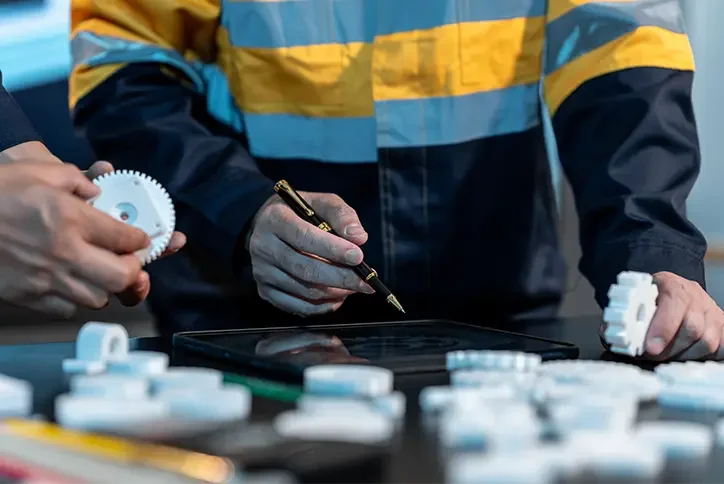
Plastic components can solve problems in industrial equipment that are difficult or costly to address with metal. Depending on the application, they can reduce weight, provide electrical insulation, resist corrosion, reduce friction, or combine multiple functions into a single part. For engineers, however, using plastic involves ensuring that the component works within the larger assembly and performs under its actual operating conditions. Loads, temperature, movement, chemical exposure, and the component's connections to surrounding parts can all affect the design. Understanding where plastic offers advantages and where it presents limitations helps engineers determine when a custom plastic component is a good fit.
Look Beyond a Direct Material Swap
Replacing a metal component with plastic does not always mean finding a plastic with similar strength. Plastics respond differently to sustained loads, temperature changes, and other operating conditions. A component that performs well in metal may need a different geometry or material when redesigned in plastic.
This can also create an opportunity to improve the component rather than simply reproduce it. Plastic molding can incorporate features such as ribs, bosses, clips, guides, and mounting points into the part. These features can add strength and change how the industrial plastic component functions within the assembly.
Use Plastic Where Its Properties Add Value
Weight reduction is one reason engineers consider industrial plastic components, particularly for moving assemblies, operator-accessible equipment, and systems where inertia affects performance. Reducing component weight can decrease loads on bearings, actuators, guides, and support structures. In some applications, it may also lower energy consumption or allow the use of smaller mechanical components elsewhere in the assembly. The material still needs to meet the application's requirements for load, stiffness, and dimensional stability.
Plastic can also provide functional properties that are difficult or expensive to achieve with metal alone. For example, electrically non-conductive materials can isolate components without requiring secondary insulating parts; corrosion-resistant plastics can eliminate coatings or surface treatments in applications exposed to moisture, washdown procedures, chemicals, or outdoor environments; or materials with low coefficients of friction may reduce wear between mating components and minimize lubrication requirements in certain applications. Understanding the failure modes and operating conditions of the existing metal component helps determine which material characteristics should drive the redesign.
Account for Plastic-to-Metal Interfaces
Industrial equipment rarely consists entirely of plastic or metal components. Most assemblies combine both materials, making the interface between them a critical part of the design. Fasteners can create localized stress concentrations that may not be significant in metal parts but can affect long-term performance in plastic. Differences in thermal expansion can also influence dimensional stability, alignment, and fit when equipment operates across a wide temperature range.
Threaded inserts, molded-in hardware, and load-distribution features are often used to improve fastening performance. For example, a fastening point designed for a machined aluminum component may require a larger boss or reinforced geometry when converted to plastic. The component needs to be secured, but loads also need to be distributed throughout the structure in a way that supports long-term durability.
Engineers should also consider how the assembly will be manufactured and serviced. Repeated disassembly, torque requirements, vibration, and impact loading can all influence connection design. Evaluating these factors early helps reduce the risk of cracking, loosening, or dimensional changes during the life of the equipment.
Consider Movement and Wear
Many industrial plastic components are used to guide, separate, support, or position moving parts. Bushings, wear strips, chain guides, rollers, spacers, and similar components often rely on material properties that differ significantly from metal. Certain engineered plastics can provide low-friction surfaces, minimize noise during operation, and reduce wear on mating components.
Wear performance, however, depends on the operating environment as much as the material itself. Contact pressure, sliding speed, temperature, contamination, lubrication, and the surface finish of mating components all influence service life. A material that performs well in a lightly loaded guide application may wear rapidly under higher loads or in abrasive environments.
Engineers should evaluate the complete wear system rather than the plastic component alone. Factors such as shaft material, alignment, operating cycle, exposure to debris, and maintenance practices can influence performance as much as the plastic material itself. Reviewing these conditions during the design phase can help prevent premature wear and unplanned equipment downtime.
Account for Creep Under Sustained Loads
Creep is another consideration when a plastic component carries a load for an extended period. Unlike a short-term strength test, a sustained load can cause gradual deformation over time. Higher temperatures can increase this effect.
This does not rule out plastic for loaded components. The expected load, duration, temperature, geometry, and material need to be considered together when designing the part. A component that meets a short-term strength requirement may still need a different design to maintain its dimensions over its service life.
Know When a Custom Component Makes Sense
Successful metal-to-plastic conversions usually result from evaluating the complete assembly rather than focusing on a single component. A redesigned part may affect adjacent components, assembly processes, maintenance procedures, and long-term equipment performance.
For example, replacing a fabricated metal assembly with a molded plastic component may eliminate brackets, hardware, spacers, or secondary assembly operations. Changes to geometry can also improve cable routing, simplify installation, reduce component handling, or improve access during service. These benefits are often identified only when the complete assembly is reviewed rather than when the component is treated as an isolated design project.
Looking at the broader system also helps identify potential risks. Material changes can affect load paths, thermal behavior, tolerances, and wear patterns throughout the equipment. Evaluating these interactions early in the design process can reduce engineering changes later and improve the likelihood of a successful implementation.
Involve the Molder Early
Once an engineer has determined that a plastic component may be a good solution, involving the molding manufacturer before the design is finalized can provide useful production input. The manufacturer can review manufacturability, tooling considerations, material processing, tolerances, and other factors that affect production. This is particularly valuable for complex parts or higher-volume programs.
Early manufacturing input can also help identify changes that would be easier to make before tooling begins. This brings manufacturing considerations into the design process while changes are still easy and cost-effective to make. Early involvement helps the final component meet both its functional requirements and its production needs.
Choose E-S Plastics For Industrial Plastic Components
At E-S Plastics, we are committed to providing quality solutions for all your plastic injection molding needs. We work with customers to evaluate molded plastic alternatives for metal components, including material options that can behave more like aluminum in specific applications. If you are reviewing a metal component for cost, weight, or production reasons, we can review the part requirements and help determine whether plastic molding is a viable option.