
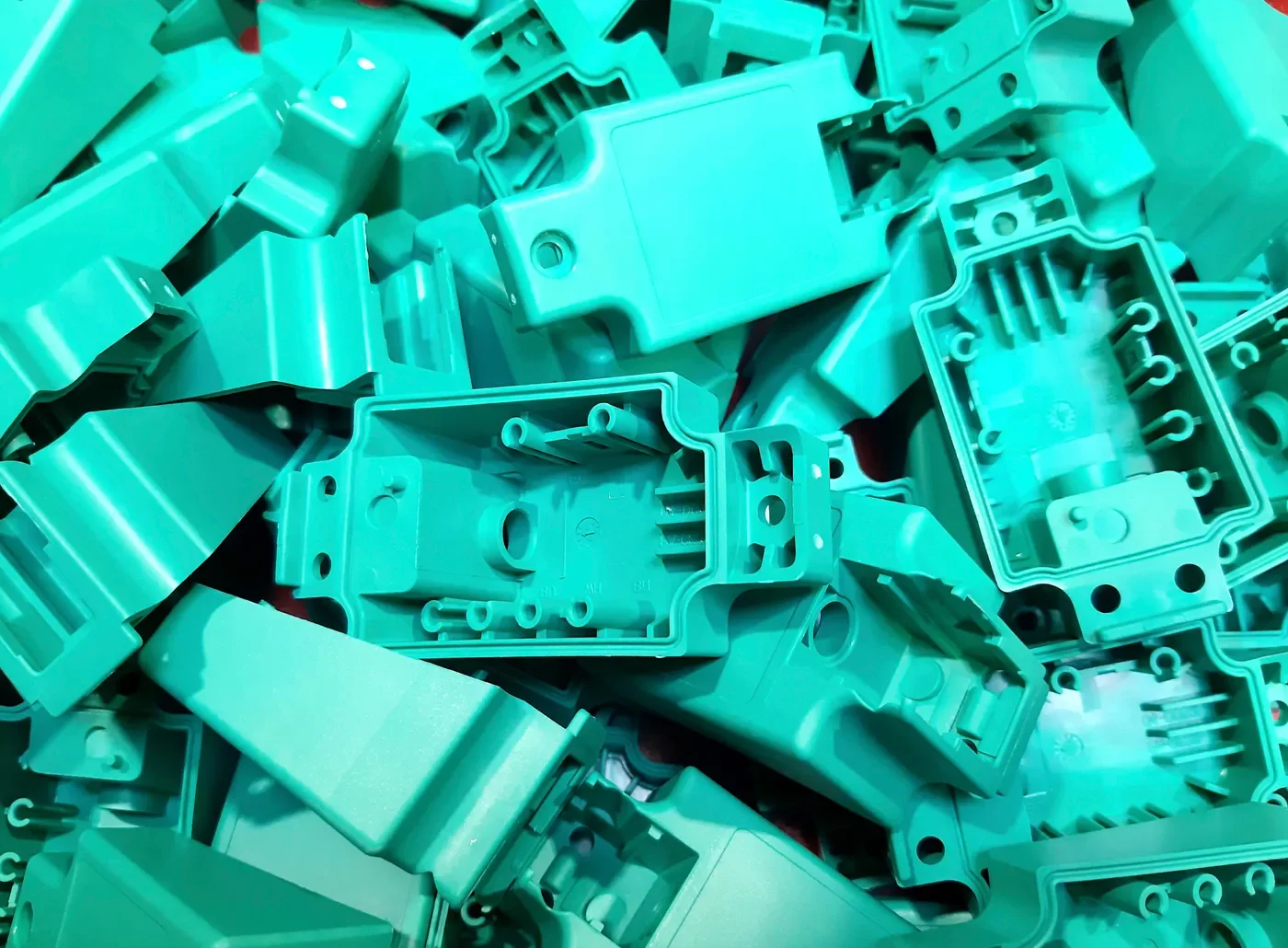
Dimension tolerances of an industrial plastic part must take into account its fit and function. Many of these injection-molded components mate with other components, carry hardware, maintain clearances, provide mounting points, protect internal systems, or become part of a larger assembly. The molding program must consider what happens to the part from design through assembly and repeat production to accommodate this.
Tolerance and Assembly
When two components must mate during assembly, critical dimensions must be repeatable. A mounting hole that shifts slightly creates an assembly problem downstream. The same applies to sealing surfaces, snap features, bosses, alignment features, bearing surfaces, and areas that interface with hardware.
However, a drawing filled with tight tolerances does not necessarily produce a better part. Critical dimensions should reflect how the component functions within the assembly. Applying unnecessarily tight tolerances elsewhere can make molding and inspection more demanding, driving up cost without improving equipment performance.
The surrounding assembly can also constrain how a plastic component responds to dimensional change. Plastics expand and contract with temperature, and some materials absorb moisture. A component captured between rigid metal parts, for example, may behave differently than one with room to move. Material behavior, part geometry, and the mating assembly need to be considered together.
Attachment Features
Attachment features, such as bosses, inserts, threaded features, snap fits, and mounting tabs, allow plastic parts to be assembled without extra fasteners, reducing cost, time, and complexity while improving aesthetics and functionality. The attachment feature must be moldable run after run. For example, a snap fit feature depends on controlled dimensions and material behavior so it can flex during assembly and still engage securely. Material shrinkage and molding tolerances can change the fit, while the snap geometry must also be designed around the mold’s draw direction or accommodate additional tooling.
Attachment features can also create molding problems when they are added without enough consideration for how the surrounding plastic will behave. The finished attachment feature must function properly in the assembly. A screw boss, for example, concentrates material around a small area. Poor proportions can contribute to sink, distortion, or cracking. Metal inserts introduce another material into the component, with different thermal and mechanical properties. In insert molding, the insert is placed in the mold before the plastic is injected, so its position and retention features affect both how the part fills and how it assembles later.
Requirements After Molding
Many industrial plastic parts require additional work before reaching final assembly. For example, hardware may have to be installed, components welded together, surfaces decorated, or subassemblies completed. Any secondary operations should be considered during the design phase. If not, any number of issues can arise, such as a feature that is easy to mold may be difficult to fixture for welding or a boss may be correctly positioned but difficult to reach with assembly equipment. Looking at these operations while the molding program is being developed can expose conflicts between molding, secondary processing, and final assembly.
Choose E-S Plastics for Industrial Plastic Parts
With two Wisconsin facilities, presses ranging from 28 to 1,000 tons, in-house toolrooms, insert molding, assembly, and secondary operations, E-S Plastics is set up to take your product from design through final assembly. With a focus on manufacturability, material selection, process control, delivery expectations, and clear communication, we have built long-lasting relationships with a number of manufacturers. Whether you have a project for equipment housings, covers, guards, water-control components, power-equipment parts, or other recurring molded components, we are ready to talk. Contact us for a quote.